Introduction
Advances in medical science have always been closely linked to technological innovation. From the invention of antibiotics to robotic-assisted surgery, each breakthrough has reshaped healthcare. One of the most promising frontiers today is nanorobotics, particularly its application in targeted drug delivery. By operating at the nanoscale – often smaller than a single human cell – nanorobots offer the potential to revolutionize how diseases are treated, making therapies more precise, efficient, and personalized.
Definition
Nanorobotics for Targeted Drug Delivery is a biomedical technology that involves designing and using nanoscale robots to precisely transport and release therapeutic agents directly to specific cells, tissues, or disease sites within the body. By navigating biological environments and responding to biochemical signals, these nanorobots enhance treatment effectiveness while minimizing side effects and damage to healthy tissues.
Understanding Nanorobotics
Nanorobotics is a branch of nanotechnology that focuses on the design, fabrication, and control of microscopic machines known as nanorobots or nanobots. These devices typically range in size from 1 to 100 nanometers and are engineered to perform specific tasks inside the human body. At this scale, nanorobots can interact directly with biological structures such as cells, proteins, and DNA.
Unlike conventional robots, nanorobots are often constructed from biocompatible materials like polymers, metals, or DNA-based structures. Many are not “robots” in the traditional sense but rather smart nanosystems capable of responding to chemical signals, temperature changes, magnetic fields, or pH variations within the body.
The Need for Targeted Drug Delivery
Traditional drug delivery methods – such as oral tablets or intravenous injections – often lack precision. Once administered, drugs circulate throughout the body, affecting both diseased and healthy tissues. This can reduce treatment effectiveness and cause significant side effects. For example, chemotherapy drugs used in cancer treatment frequently damage healthy cells, leading to fatigue, hair loss, and weakened immunity.
Targeted drug delivery aims to overcome these limitations by directing therapeutic agents specifically to the affected site. Nanorobotics offers an innovative solution by enabling drugs to be delivered directly to diseased cells while minimizing exposure to healthy tissues.
How Nanorobots Enable Targeted Drug Delivery
Nanorobots can be programmed or engineered to navigate the body and release drugs only under specific conditions. Their functionality typically involves several key mechanisms:
Target Recognition:
Nanorobots are designed to recognize specific biological markers associated with disease, such as proteins found only on cancer cells or inflamed tissues. This is often achieved using ligands, antibodies, or aptamers attached to the nanorobot’s surface.
Controlled Navigation:
Some nanorobots move passively through the bloodstream, while others can be guided actively using external magnetic or acoustic fields. This allows clinicians to steer nanorobots toward a precise location within the body.
Stimulus-Responsive Drug Release:
Once the nanorobot reaches its target, it can release its drug payload in response to internal stimuli (such as low pH in tumor environments) or external triggers like light or heat.
Biodegradation and Clearance:
After completing their task, many nanorobots are designed to safely degrade into non-toxic components that the body can naturally eliminate.
Applications in Modern Medicine
Cancer Treatment:
Cancer therapy is one of the most studied applications of nanorobotics in targeted drug delivery. Nanorobots can deliver chemotherapy drugs directly to tumor cells, reducing damage to surrounding healthy tissues. Some experimental designs even allow nanorobots to block blood supply to tumors, effectively starving cancer cells.
Cardiovascular Diseases:
Nanorobots can target arterial plaques, delivering drugs that dissolve clots or reduce inflammation. This approach may significantly reduce the risk of heart attacks and strokes while avoiding systemic side effects.
Neurological Disorders:
The blood-brain barrier presents a major challenge for drug delivery to the brain. Nanorobots can be engineered to cross this barrier, offering new treatment possibilities for conditions such as Alzheimer’s disease, Parkinson’s disease, and brain tumors.
Infectious Diseases:
Nanorobotics can be used to target bacteria or viruses directly, improving the effectiveness of antimicrobial therapies and helping combat antibiotic resistance by delivering drugs precisely where pathogens reside.
Advantages Over Conventional Drug Delivery
Nanorobotics-based drug delivery offers several notable benefits:
- High Precision: Drugs are released only at the disease site.
- Reduced Side Effects: Minimal interaction with healthy tissues.
- Lower Dosage Requirements: Increased efficiency reduces the amount of drug needed.
- Personalized Treatment: Nanorobots can be tailored to individual patients and disease profiles.
- Improved Patient Compliance: Potentially fewer treatments and reduced discomfort.
Challenges and Limitations
Despite its enormous potential, nanorobotics for targeted drug delivery faces several challenges:
Technical Complexity:
Designing nanorobots that function reliably inside the human body is extremely complex. Factors such as immune response, stability, and precise control remain areas of active research.
Safety and Toxicity:
Long-term safety is a critical concern. Researchers must ensure that nanorobots do not accumulate in organs or trigger harmful immune reactions.
Manufacturing and Cost:
Producing nanorobots at scale with consistent quality is expensive and technologically demanding, which may limit accessibility in the short term.
Regulatory and Ethical Issues:
Since nanorobotics involves introducing artificial systems into the body, regulatory approval processes are rigorous. Ethical considerations related to privacy, control, and misuse must also be addressed.
Future Prospects
The future of nanorobotics in targeted drug delivery is highly promising. Ongoing research is exploring DNA-based nanorobots, AI-assisted control systems, and self-learning nanosystems capable of adapting to changes within the body. As technology advances, nanorobots may not only deliver drugs but also diagnose diseases, repair tissues, and monitor health in real time.
Clinical trials are already underway for several nanoparticle-based drug delivery systems, and fully autonomous nanorobots may become a reality within the next few decades. Their integration with personalized medicine could redefine how diseases are prevented and treated.
Growth Rate of Nanorobotics for Targeted Drug Delivery Market
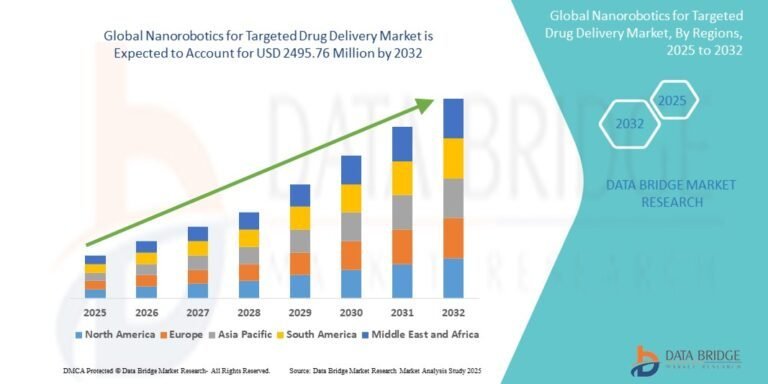
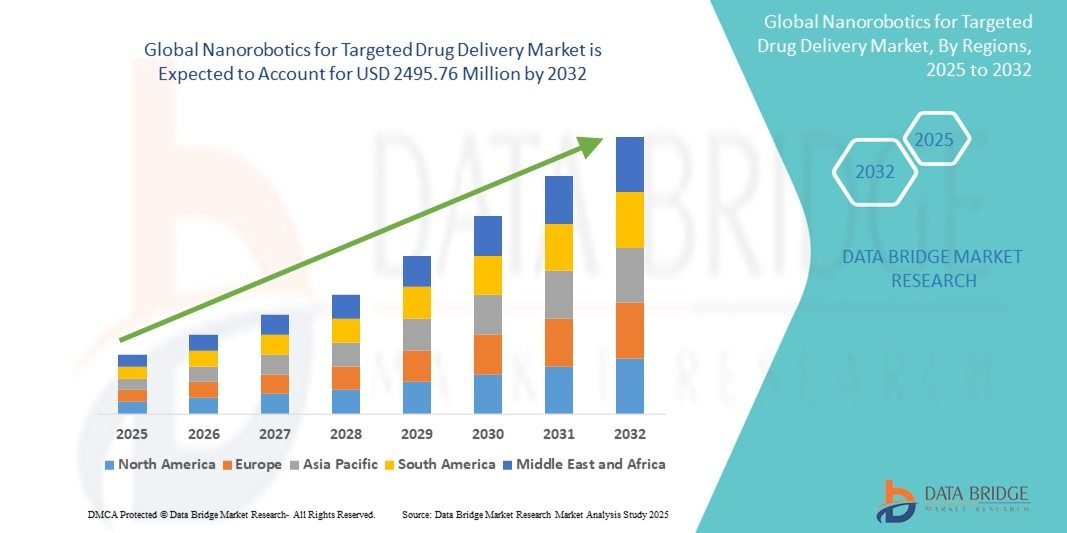
According to Data Bridge Market Research, the nanorobotics for targeted drug delivery market was estimated to be worth USD 317.49 million in 2024 and is projected to grow at a compound annual growth rate (CAGR) of 29.40% to reach USD 2495.76 million by 2032.
Learn More: https://www.databridgemarketresearch.com/reports/global-nanorobotics-for-targeted-drug-delivery-market
Conclusion
Nanorobotics for targeted drug delivery represents a transformative leap in healthcare technology. By combining precision engineering with biological intelligence, nanorobots have the potential to make treatments safer, more effective, and more personalized than ever before. While challenges remain, continued research and innovation are steadily bringing this futuristic concept closer to everyday medical practice. As nanorobotics evolves, it promises not just to treat disease, but to fundamentally change the way we think about medicine itself.