In regulated industries, audits and inspections are rarely derailed by major failures. More often, they stall because of something deceptively simple: documents. Missing approvals, outdated procedures, unclear revision histories, or inconsistent records across sites can quickly turn a routine inspection into a series of observations, follow-up questions, and delays.
Smart document control is no longer just an administrative function. It has become a strategic capability that directly impacts audit outcomes, inspection timelines, and regulatory confidence. Organizations that invest in structured, intelligent document control consistently experience fewer audit findings and smoother inspections, even as regulations become more complex.
Why documents are at the center of audits and inspections
Auditors and inspectors rely on documents to understand how an organization operates. Policies, procedures, records, and approvals collectively tell the story of compliance. When that story is incomplete or inconsistent, it raises red flags.
Common document-related issues that trigger audit findings include:
Procedures that do not match actual practices
Obsolete documents still accessible or in use
Missing evidence of review, approval, or training
Inconsistent versions across departments or locations
Even well-run organizations can struggle when documentation is managed through shared drives, email attachments, or disconnected systems. These methods make it difficult to prove control, especially under time pressure.
What smart document control really means
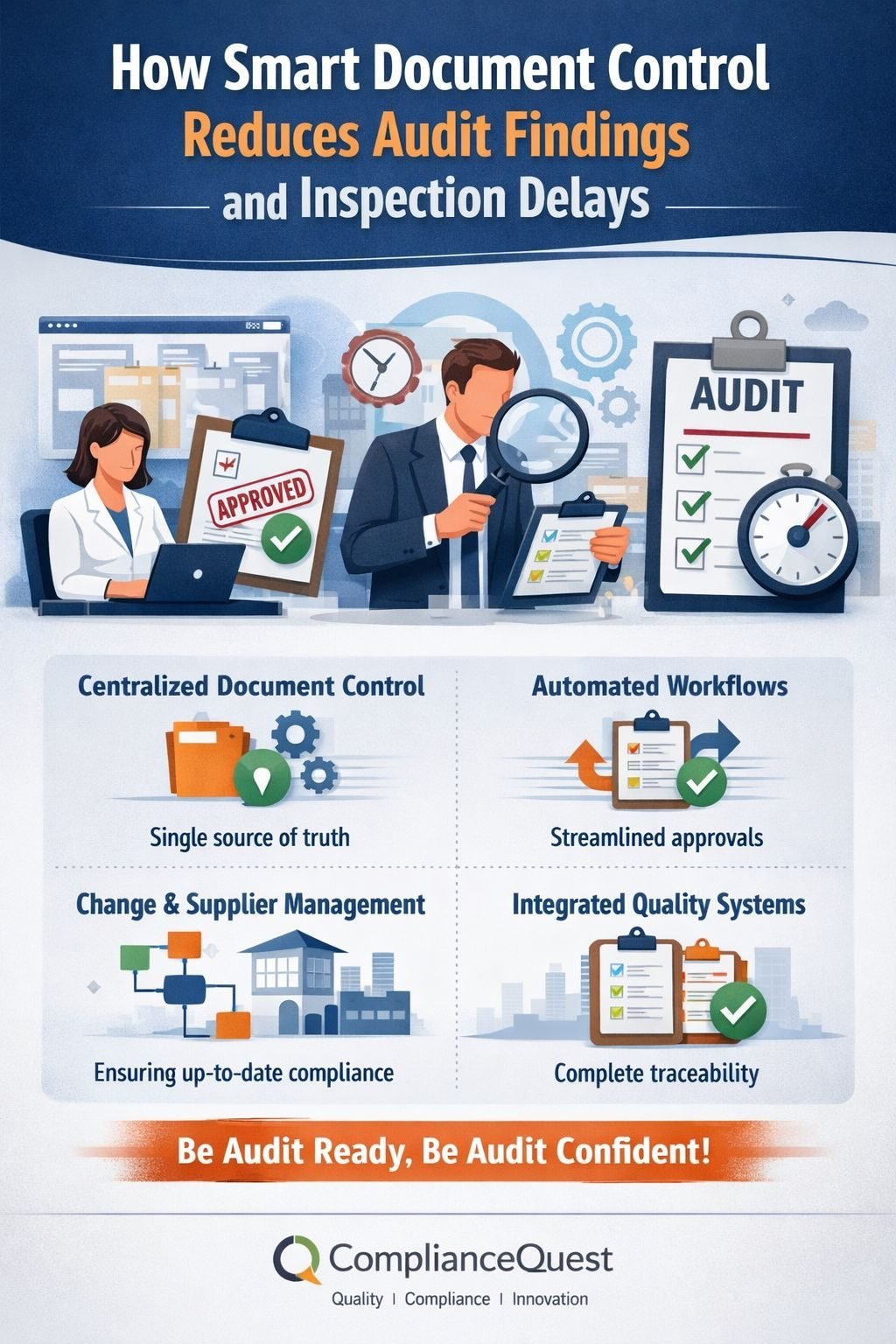
Smart document control goes beyond storing files digitally. It introduces structure, automation, and traceability into the entire document lifecycle.
At its core, Document Management Software enables organizations to:
Standardize how documents are created, reviewed, approved, and retired
Ensure only current, approved documents are available for use
Maintain complete audit trails for every change and decision
This level of control transforms documents from static files into living compliance assets that support daily operations and regulatory expectations.
Reducing audit findings through consistency and control
One of the most common audit findings relates to lack of consistency. Different versions of the same procedure, unclear ownership, or missing approvals can undermine confidence in the quality system.
Smart document control addresses these risks by enforcing consistency across the organization.
Key benefits include:
Controlled workflows that ensure documents follow defined review and approval paths
Role-based access that prevents unauthorized changes
Automated versioning that eliminates confusion over which document is current
When auditors ask for a procedure or record, teams can retrieve it immediately, confident that it is accurate and approved. This alone eliminates a large percentage of avoidable findings.
Accelerating inspections with instant evidence availability
Inspection delays often occur not because evidence does not exist, but because it cannot be located quickly. Searching through folders, emails, or legacy systems consumes valuable time and creates unnecessary tension during inspections.
Smart document control centralizes information and makes it searchable. Inspectors can be provided with requested documents promptly, reducing interruptions and follow-up requests.
This capability is especially critical when documents are linked to broader quality processes, such as:
Deviations and nonconformances
Training records
Supplier qualifications and agreements
When documentation is connected rather than siloed, inspections move faster and with fewer disruptions.
Managing change without losing compliance control
Change is inevitable, whether driven by regulatory updates, process improvements, or product modifications. However, unmanaged change is a major source of audit findings.
Effective document control works hand in hand with Change Management Software to ensure changes are introduced in a controlled and compliant manner.
This includes:
Assessing the impact of changes on existing documents
Updating affected procedures and records systematically
Ensuring training and implementation occur before changes go live
By linking document updates directly to change workflows, organizations can demonstrate to auditors that changes are deliberate, reviewed, and fully implemented, rather than reactive or informal.
Strengthening supplier oversight through documentation
Suppliers play a critical role in compliance, particularly in regulated supply chains. Missing or outdated supplier documentation is a frequent inspection issue.
Smart document control supports Supplier Management Software by ensuring:
Supplier agreements, certifications, and audits are current and accessible
Changes in supplier status trigger document reviews and updates
Documentation aligns with internal quality and risk requirements
This visibility allows organizations to demonstrate effective supplier oversight, reducing the likelihood of findings related to external partners.
Document control as the foundation of quality systems
Documents are not isolated artifacts; they underpin every quality process. Training, audits, CAPAs, risk management, and supplier oversight all depend on accurate and controlled documentation.
Modern Quality Management Software integrates document control into the broader quality ecosystem. This integration enables:
Automatic linking of procedures to training requirements
Traceability between documents, incidents, and corrective actions
Real-time insight into document effectiveness and usage
When auditors see this level of integration, it signals maturity and control, significantly reducing scrutiny and follow-up actions.
Cultural impact of smart document control
Beyond systems and processes, smart document control influences organizational culture. When employees trust that documents are current and reliable, compliance becomes part of everyday work rather than an audit-driven activity.
Cultural benefits include:
Reduced reliance on tribal knowledge
Greater accountability for document ownership
Improved collaboration across teams and locations
This cultural shift further reduces audit risk by embedding compliance into normal operations.
Turning inspections into validations, not disruptions
Organizations with smart document control approach inspections with confidence. Instead of scrambling to respond to requests, they are prepared to demonstrate control, consistency, and traceability.
The result is:
Fewer audit findings related to documentation
Shorter inspection durations
Stronger relationships with regulators and auditors
Over time, this readiness builds regulatory trust, which can lead to smoother future inspections and faster approvals.
The strategic value of investing in document control
While document control is often viewed as a compliance necessity, its strategic value extends far beyond audits. It improves operational clarity, reduces rework, and supports scalable growth.
As regulations evolve and organizations expand globally, smart document control becomes essential for maintaining consistency without sacrificing agility.
For organizations seeking to modernize document control within an integrated quality ecosystem, ComplianceQuest provides a unified platform that connects documents with change, supplier, and quality processes. By embedding smart document control into daily operations, ComplianceQuest helps organizations reduce audit findings, avoid inspection delays, and maintain continuous compliance with confidence.